I just so happened upon a random post that piqued my interest on LinkedIn. I know LinkedIn! That’s typically where office memes go to die.
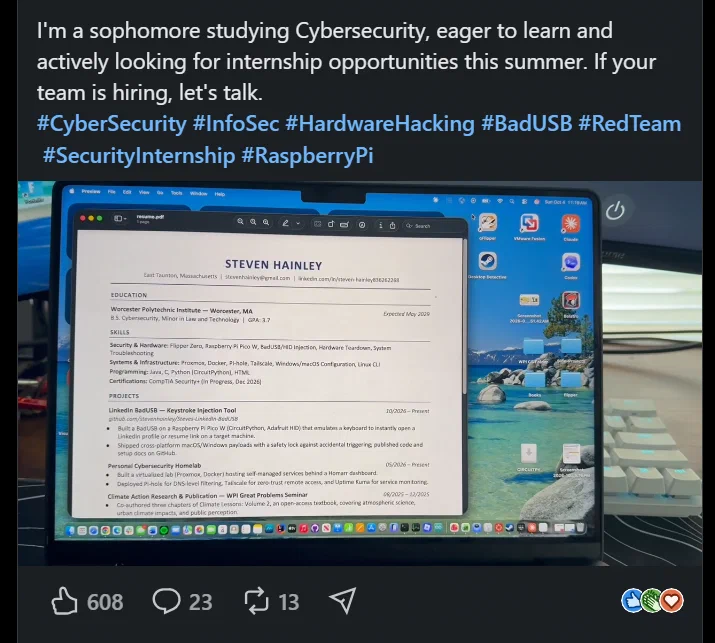
It was a student, Steven Hainley, from Worcester Polytechnic Institute in Massachusetts majoring in Cybersecurity with a minor in law. His post was compelling. He was showing off a simple yet ingenious BadUSB at a career fair that as soon as you plugged into any laptop in a flash it pulled up his resume and LinkedIn.
A BadUSB is a modified USB device that is flashed with malicious firmware. It looks like a normal USB thumbdrive but can act like a keyboard, network adapter or other interfaces. This allows for covert command injection but in Steven’s case just displays his resume.
A huge thank you to Steven as he sat down with me and answered a few questions about his career and his unique BadUSB device that he showed off at a career fair.
Nonetheless, it reminded me of the need to showcase your practical skills. In an era, where each job posting get on an average of 244 applications and 81% of recruiters spend under a minute on a resume.
It’s easy to hear people complain about the job market but rarely do you see people want to step out of the comfort zone of the resume. The one or two pages must summarize all our capabilities. A few lines of ink, a few bytes on your hard drive must encapsulate your proficiency at the job.
That’s why its a breath of fresh air when someone like Steven finds new ways to stand out. Not just doing what the other 243 applicants chose to do and send a two page pdf.
And YES you heard that right! According to the Greenhouse, applications per job rose exponentially from 115 to 244 applicants per job. This saturation of the job market means standing out is so much more important.
As Steven put it, “Anyone can generate a clean bullet point. Not everyone can hand you a device that does something.” Handing a manager proof of your work, Steven is bridging the MASSIVE gap in IT of theoretical knowledge and practical execution. Proof or better yet a physical device instantly turns the interview around. You’re no longer a candidate. You are a practitioner who is displaying his skills. You must be able to honestly sell yourself not in just words but in practice. As Linus Torvalds would say, “Talk is cheap. Show me the code.”
Let’s talk numbers
Doom and gloom can be easy to fall into when you hear the phrase “Lets talk numbers” and while I’m not your accountant, I am legally obligated to tell you these upcoming application stats are going to hurt a little.
Only three percent reached an interview from online applications. Referred candidates were 13 times more likely to get an interview than online applicants.
I ran some numbers. To put this in perspective, your odds of winning any prize in the Powerball are 1 in 24.9, or roughly 4%. That means you are statistically more likely to walk into a gas station, buy a random lottery ticket, and win money than you are to get a callback from a blind PDF submission in a Workday portal.
You may lose the job not because of a better candidate but simply because you weren’t able to get your foot in the door. I remember spending hours agonizing over my resume. However, 81% of recruiters spend under a minute per resume. That’s human nature though. We all have short attention spans.
The clock is ticking right when the PDF hits their screen. This is exactly why Steven’s BadUSB stunt is so brilliant. It forgoes the quick glance of a resume to a demonstration of his skills.
The standard two-page resume is what gets you thrown into the 97% rejection pile with the other 243 applicants. Tangible, hands-on proof is what pulls you out.
You can spend your weekend tweaking the margins on your PDF. Or you can find your own BadUSB.
I’d recommend starting now. Here’s my 3 short simple details I’ve noticed that make a difference.
- Be Specific. Don’t let AI write your resume. People love a little splash of personality. Tell them about your family or the hobby you can’t stop talking about. Show them you’re not a robot.
- Be Scrappy. Use what you’ve got. An old laptop can become your first home lab. Free cloud tiers and practice sites like TryHackMe cost nothing to start. You don’t need a big budget to show real skills.
- Be Specialized. Want to be a security analyst? Don’t wait for a job to hand you a network. Build a vulnerable Windows machine in your home lab and scan it with Nessus. Bring a printed write-up of how you triaged each finding.
Find Your BadUSB
There’s good news. Tech unemployment peaked at 4.0% in November 2025. By October 2026, it was back down to 2.8%, well under the national rate of 4.1%.
The jobs are coming back but there’s still plenty of demand.
That’s why proof matters more than ever in a job market where entry level positions require three years of experience. Steven said it best. “The whole point was to hand someone something that does something instead of something they throw away.”
So build something. Post it. Send the link. Your resume gets seven seconds. Your work can get you the interview.
Sources
Applications per job and entry-level applicants (Figs. 1–2)
- Greenhouse, The Hire Standard: Greenhouse Benchmark Report, North America, March 2026. Platform data from 640M+ applications at 6,000+ companies, 2022–2025. (PDF)
- iCIMS, iCIMS Insights June Workforce Report, June 24, 2025. Platform data from thousands of US companies.
Interview rate by source (Fig. 3)
- Ashby, Are referred candidates more likely to get hired?, May 15, 2025. 38M+ applications across 93K jobs, 2021–2024.
Time spent on an initial résumé screen (Fig. 4)
- ResumeGo, Survey: How Much Time Do Recruiters Spend On A Resume?, March 2024. Survey of 418 US recruiters and hiring managers, Jan–Mar 2024.
Tech occupation unemployment rate (Fig. 5) CompTIA Tech Jobs Reports, analyzing monthly Bureau of Labor Statistics data:
- June 2025, released July 3, 2025
- August 2025, released Sept 5, 2025
- November 2025, released Dec 16, 2025
- December 2025, released Jan 9, 2026
- January 2026, released Feb 11, 2026
- February 2026, released March 6, 2026
- March 2026, released April 3, 2026
- April 2026, released May 8, 2026
- May 2026, released June 5, 2026
- June 2026, released July 2, 2026
- October 2026, released Nov 6, 2026
Every article is human-written, not AI-generated.